Welding stainless steel for continuous high-temperature environments?
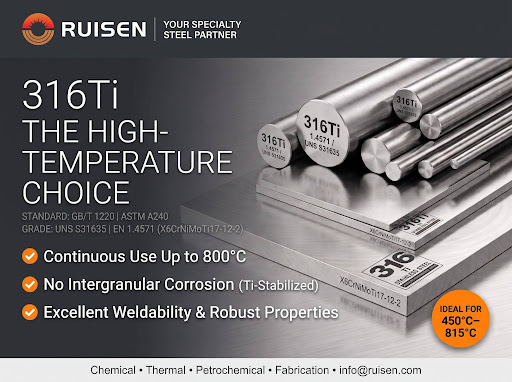
It might be time to look beyond standard 316L. Let’s talk about 316Ti (UNS S31635 / EN 1.4571)—the preferred material for high-temperature welding applications.
Here is a breakdown of why this titanium-stabilized alloy deserves a spot in your material specs:
316Ti is essentially standard 316 stainless steel with a crucial addition: Titanium (Ti). During high-temperature operations or welding, the titanium preferentially bonds with carbon in the alloy. This chemical reaction prevents chromium carbide from precipitating, effectively eliminating the risk of intergranular corrosion. Meanwhile, the retained Molybdenum (2-3%) ensures excellent resistance to chloride pitting and crevice corrosion.
Unmatched Thermal Stability The real superpower of 316Ti is how it handles the heat.
- Continuous Use: It can operate continuously at temperatures up to 800°C (note: this limit should be lowered if the metal is under stress in highly corrosive media).
- Short-Term Limit: It can withstand short-term oxidation at temperatures between 870°C and 900°C.
- The Differentiator: In the critical “sensitization zone” of 425°C–815°C, ordinary 316 and 316L are highly susceptible to rust and corrosion. 316Ti, however, remains completely stable for long-term service.
This alloy boasts slightly better yield strength (≥205MPa) and tensile strength (≥520MPa) than its 316L counterpart. Even better for fabricators: it offers excellent weldability and requires absolutely no post-weld solution heat treatment.
316Ti vs. 316L: Which to Choose?
| Feature | 316Ti | 316L |
| Stabilization Method | Titanium addition | Ultra-low carbon |
| Long-Term 450–815°C Use | ✅ Highly Applicable | ❌ Not Recommended |
| Cost & Sourcing | ~8-15% more expensive | Better value, widely available |
Where is 316Ti Used?
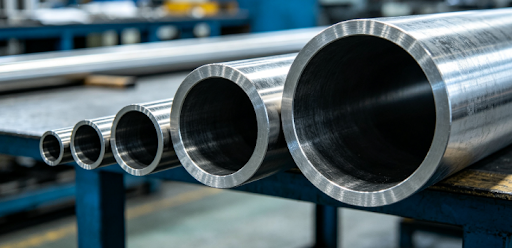
- Chemical Industry: High-temperature pipes, heat exchangers, reaction vessels, and bellows.
- Thermal Boilers: Exhaust systems, tail gas pipes, and high-temperature boiler fittings.
- Petrochemical: Desulfurization equipment and structures facing high-temp corrosive conditions.
- Fabrication: Any complex welded stainless steel structures where post-weld heat treatment is physically impossible.
The Golden Rule for Engineers: If your welded equipment will operate long-term in the 450°C–815°C range, specify 316Ti. If it will operate at room temperature, save the budget and stick to 316L.